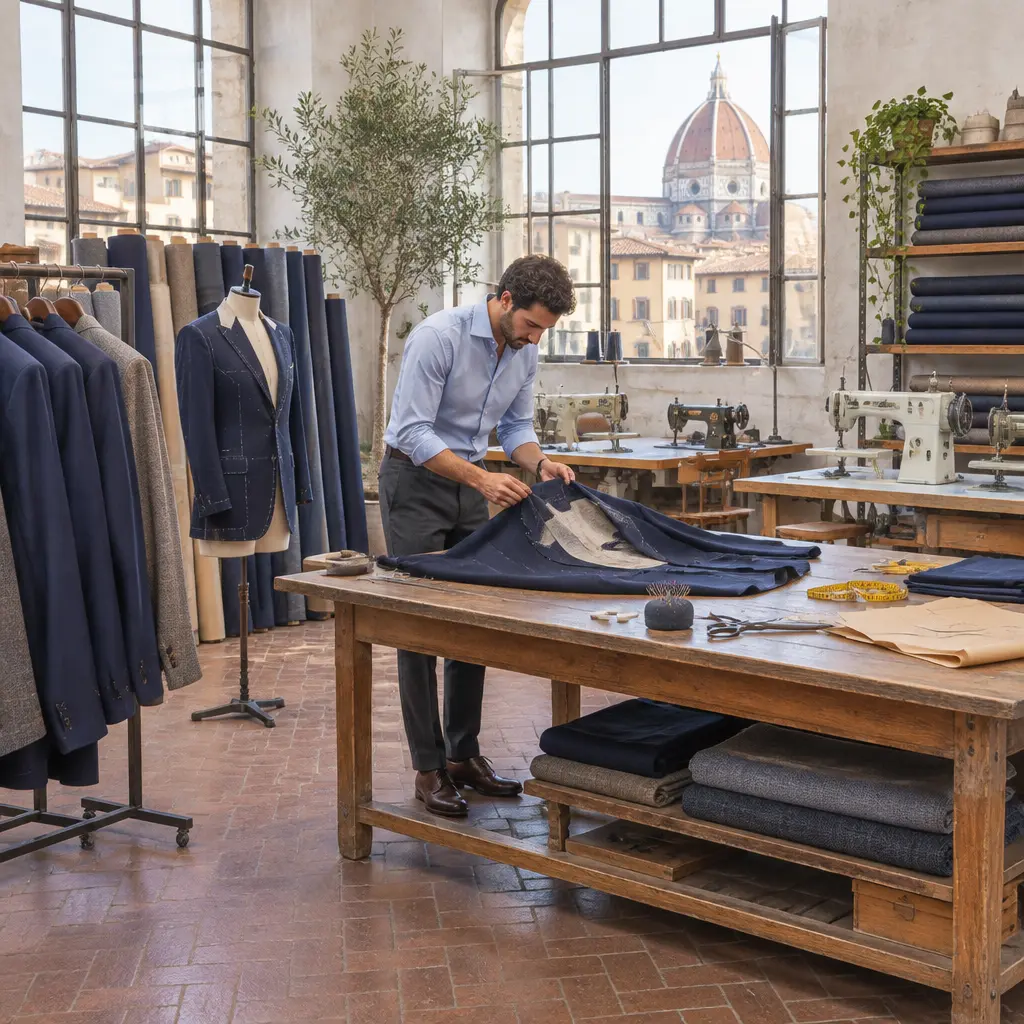
A suit labeled “Made in Italy” is a suit whose origin claim must meet Italian and European rules—not a guarantee that every fabric, component, or production step is Italian, nor a standardized promise of a particular level of quality. For clothing, the European Union’s non-preferential origin rules generally look to the country where the last substantial, economically justified transformation took place. In practice, that makes the details of a suit’s production, its label, and the brand’s documentation more informative than the phrase alone. Understanding those distinctions helps shoppers assess craftsmanship, fabric provenance, and value, while also explaining why Italian origin claims matter to a fashion industry that Italy’s national fashion association, Confindustria Moda, describes as a major manufacturing sector.
“Made in Italy” Suit Origin and Legal Meaning
“Made in Italy” is a country-of-origin claim. The European Commission explains that, when a product involves more than one country, non-preferential origin is generally assigned to the country where the last substantial, economically justified processing or working occurred, resulting in a new product or representing an important stage of manufacture. The rules are not a simple checklist requiring every input to come from that country.
For suits, the practical question is therefore where the legally significant manufacturing operations occurred—not simply where the cloth was woven, where the brand is headquartered, or where the garment was designed. The phrase can describe a product with imported materials if its qualifying transformation took place in Italy. Conversely, an Italian brand name or Italian design does not by itself establish that a suit was made in Italy.
Country of origin is different from material origin
A suit’s country-of-origin statement and its fiber or fabric information answer different questions. A wool suit may be cut and assembled in Italy from cloth woven elsewhere; the garment’s origin claim does not necessarily mean the wool was raised, spun, or woven in Italy. The European Union’s textile-labeling rules separately require information about textile-fiber composition, while origin claims are addressed through customs and consumer-protection frameworks.
A label is not a complete manufacturing history
“Made in Italy” does not, by itself, disclose where the lining, buttons, canvas, or other components were produced, or which individual operations took place in Italy. Nor does it automatically certify handwork, a particular construction method, or a quality grade. For a more complete picture, check the garment label and product description, then ask the seller for details about fabric origin, construction, and manufacturing location.
How Italian Suit Production Shapes the Origin Claim
A suit is a multi-part garment, so its production can involve several specialist processes and suppliers. Cutting and assembling the jacket and trousers are central manufacturing stages, but the precise origin assessment depends on the applicable rules and the facts of the product’s supply chain. The European Commission’s “last substantial transformation” principle provides the broad framework; it does not mean that any single finishing step automatically qualifies a garment for Italian origin.
Cutting, assembly, and finishing
Suit production typically includes pattern-making, cutting fabric, assembling panels, setting sleeves, adding linings and closures, pressing, and finishing. Where these operations occur can help explain the garment’s manufacturing story, but consumers should avoid assuming that “Made in Italy” means every step happened in one workshop. A brand that provides a clear account of where its suit was cut, sewn, and finished offers more useful evidence than a country label alone.
Tailoring traditions and construction are separate questions
Italian tailoring is not one uniform style or production method. Regional traditions and individual makers differ in silhouette, canvas, shoulder construction, and finishing. A suit may be Italian-made and machine-assembled, or it may include substantial handwork; neither detail can be inferred reliably from the country-of-origin wording. Ask whether the jacket is fused, half-canvassed, or full-canvassed, and what the maker means by “handmade” if those features matter to your purchase.
Fabric, components, and supply-chain transparency
Cloth mills and garment makers are distinct parts of the suit supply chain. A label naming an Italian mill can indicate where cloth was made, while “Made in Italy” ordinarily refers to the garment’s origin claim. Buyers seeking Italian fabric as well as Italian garment production should look for both pieces of information, along with details on fiber composition and component sourcing. The European Union’s textile rules make fiber-composition information a separate, relevant point of comparison.
What “Made in Italy” Does—and Does Not—Tell Suit Buyers
The label can be a useful starting point, but it is not a substitute for evaluating fit, materials, construction, and the seller’s evidence. Italy’s fashion industry includes a broad network of manufacturers and specialist suppliers, yet the country name alone does not establish that a particular suit is durable, ethically produced, or worth its price.
It indicates an origin claim, not an automatic quality grade
Quality depends on measurable and observable product attributes: fabric composition and weight, seam and buttonhole execution, internal construction, fit, and repairability. Two suits carrying the same origin wording may differ substantially in all these respects. Examine the garment, review its care and composition labels, and compare the construction details rather than treating origin as a quality score.
It does not necessarily mean locally sourced or sustainable
A suit can meet an origin rule while using materials or components sourced internationally. The claim alone does not verify environmental performance, labor conditions, or the distance traveled by each input. For those concerns, look for specific, verifiable disclosures—such as named mills, traceability information, recognized certifications, or published supplier standards—instead of relying on a country label as a sustainability guarantee.
It is not the same as an Italian brand or Italian design
A company’s nationality, the location of its design team, and a garment’s manufacturing origin are separate facts. A suit designed by an Italian brand may be manufactured elsewhere, while a suit made in Italy may be sold under a brand based in another country. Product descriptions should make the claimed manufacturing origin clear; shoppers can ask the retailer to distinguish design, fabric production, and garment assembly.
How to Verify an Italian-Made Suit Before Buying
A practical check combines the garment’s label with specific questions about production. The following steps help distinguish a meaningful origin statement from broader marketing language.
- Read the sewn-in country-of-origin label and confirm that it says “Made in Italy,” rather than only “Italian style,” “designed in Italy,” or a similar phrase.
- Check the fiber-composition label, which provides information distinct from the garment’s country of origin.
- Ask the brand where the suit was cut and assembled, and where its cloth and major components were made.
- Request details about construction—such as fused or canvassed interlining—and whether claimed handwork applies to the whole garment or particular operations.
- Look for consistent, product-specific information across the label, retailer listing, and brand’s supply-chain disclosures. For a costly purchase, retain the product description and receipt.
Conclusion: Read “Made in Italy” as One Part of the Suit’s Story
“Made in Italy” identifies an origin claim governed by rules concerning where a product’s substantial transformation occurred; it does not promise that all materials are Italian or that a suit meets a particular standard of craftsmanship. Cutting, assembly, finishing, fabric provenance, construction, and brand identity are related but distinct details. Treat the label as a useful starting point, then verify the production story and assess the suit’s quality for yourself. Before buying, compare the origin statement with the composition label and ask the maker or retailer clear questions about manufacturing and materials.
Sources: European Commission, “Non-preferential Rules of Origin,” https://taxation-customs.ec.europa.eu/customs-4/international-affairs/origin-goods/non-preferential-rules-origin_en; European Commission, “Textile Labelling,” https://single-market-economy.ec.europa.eu/sectors/textiles-ecosystem/textile-labelling_en; European Parliament and Council, Regulation (EU) No 1007/2011 on textile fibre names and related labelling and marking, https://eur-lex.europa.eu/eli/reg/2011/1007/oj; Confindustria Moda, “The Italian Textile and Fashion Industry,” https://www.confindustriamoda.it/