The business suit is a coordinated set of tailored garments—typically a jacket and trousers, or a jacket and skirt—worn in professional settings. Over roughly two centuries, it shifted from the elaborate coats and waistcoats of early nineteenth-century gentlemen to the darker, simpler, and more standardized suits associated with modern office work. Its evolution reflects changes in industrial production, gender roles, workplace expectations, and ideas about authority and personal style. The story moves from the rise of the modern suit and its defining features to women’s adoption of tailored dress, changes in materials and manufacturing, and the suit’s changing place in today’s workplaces.
The Business Suit’s Origins and Core Attributes
The modern business suit did not appear all at once. It developed from men’s changing dress in Britain and Europe during the nineteenth century, when formal clothing gradually became less ornate and more practical. Fashion historians commonly connect this shift with the “Great Male Renunciation,” a term associated with psychologist and writer John Flügel’s 1930 account of men relinquishing elaborate display in favor of sober, restrained clothing. The phrase describes a broad cultural change rather than a single event or a precise dress code.
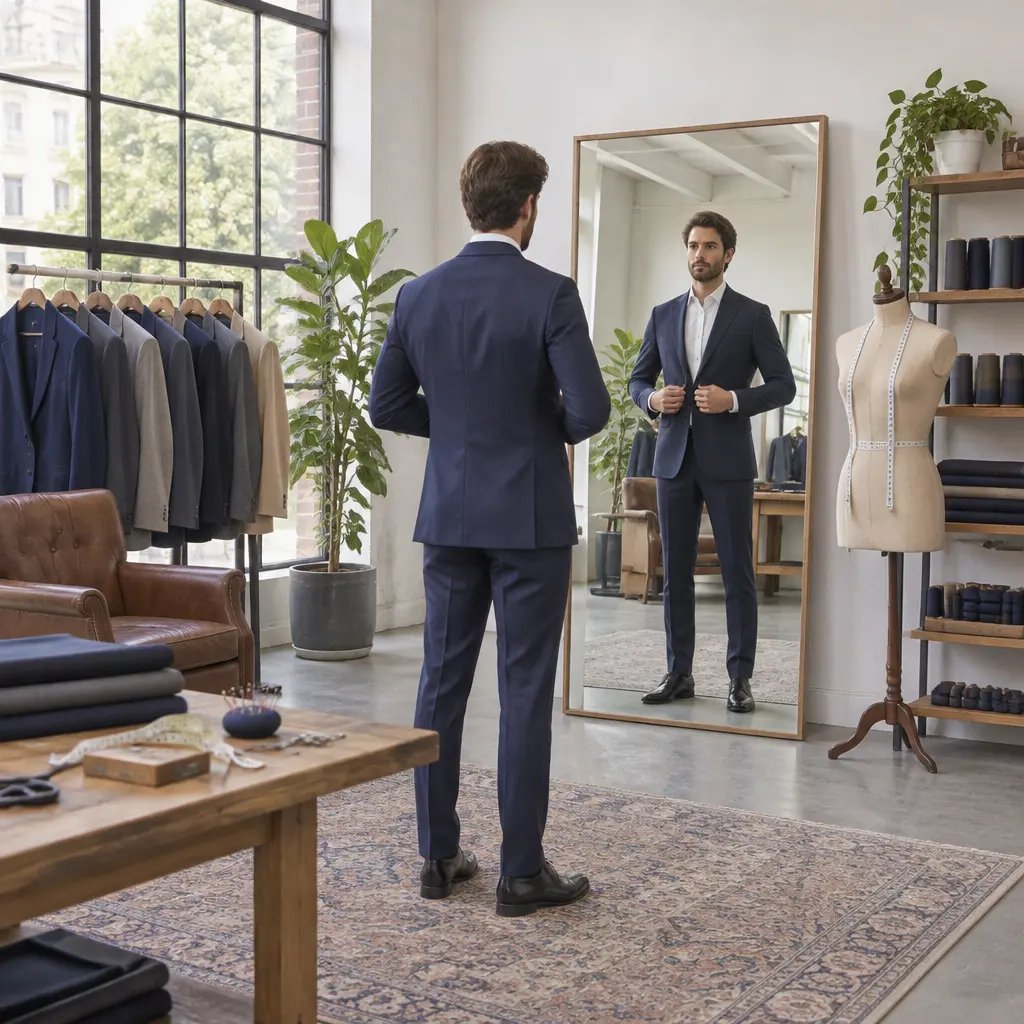
A suit’s defining attribute is coordination: its tailored pieces are made to be worn together, usually from matching fabric. The jacket’s cut, lapels, buttons, pockets, and shoulder shape distinguish one style from another, while trousers or a skirt complete the ensemble. The business suit is a social and practical category, not one fixed design; its accepted forms have changed with occupation, place, and period.
From the Frock Coat to the Lounge Suit
In the early nineteenth century, men of status often wore a frock coat with a waistcoat and trousers. The frock coat was long and structured, suitable for public and formal occasions. During the century, the shorter lounge coat—originally associated with informal country wear—gained ground in town and eventually became a foundation for the modern jacket-and-trouser suit. By the late Victorian era, matching suits were increasingly established as respectable daytime clothing for men in business and professional life.
The transition was gradual, and older and newer styles coexisted. The Metropolitan Museum of Art’s costume collections document the changing silhouettes and construction of men’s clothing across this period. The shift toward shorter jackets and matching trousers also suited a more mobile urban life: garments could be worn for travel, office work, and public business without the sweeping formality of earlier coats.
The Three-Piece Suit and the Two-Piece Suit
A three-piece suit consists of a jacket, trousers, and a matching waistcoat, also called a vest. The waistcoat preserved a layer of nineteenth-century formality and could remain visible when a jacket was removed. A two-piece suit omits it, creating a lighter and less ceremonious outfit. Both forms became familiar, with the two-piece suit especially suited to changing indoor workplaces and warmer conditions.
These categories describe construction, not a fixed level of professionalism. A well-cut two-piece suit can be formal, while a three-piece suit may be worn as a fashion choice or for ceremony. The distinction helps explain how the suit adapted without losing its central principle: coordinated tailoring.
The Business Suit’s Standardization and Industrial Change
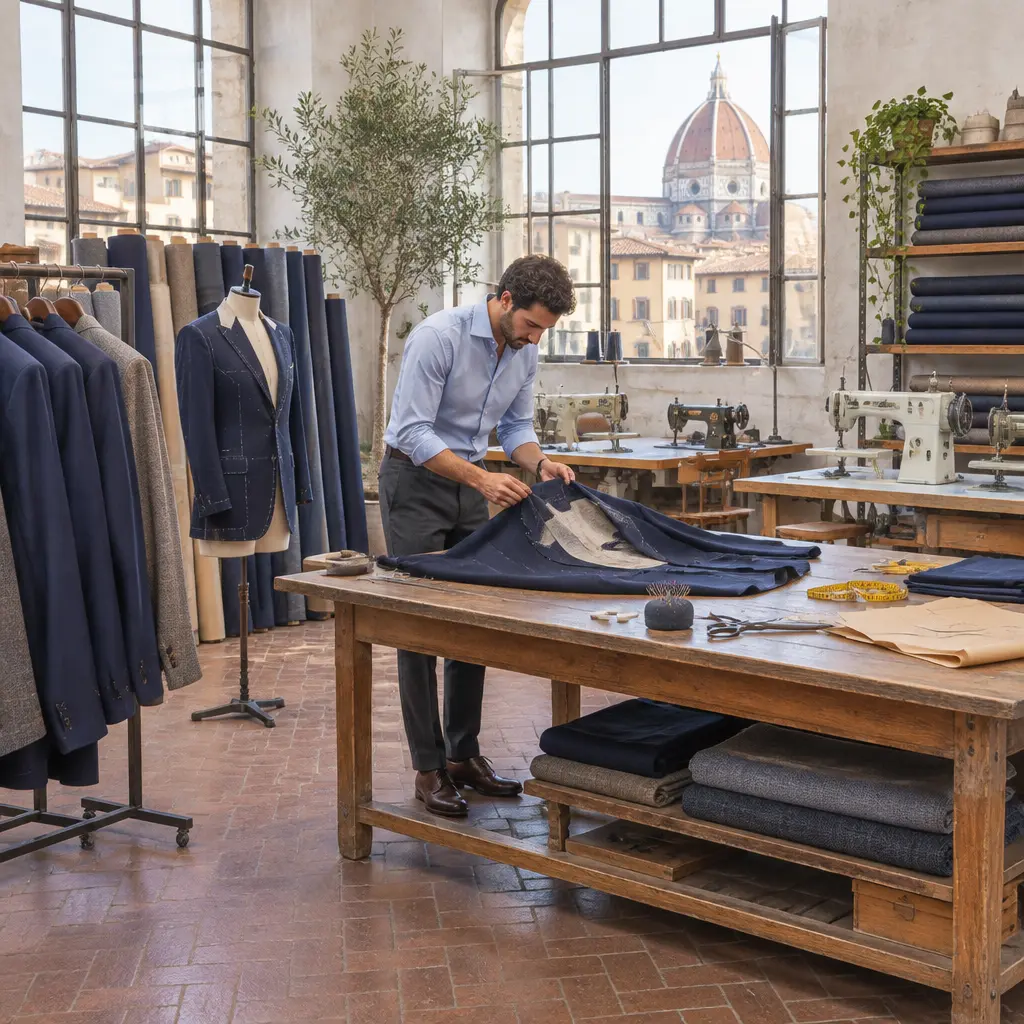
As the suit became common office clothing, its production moved beyond exclusive bespoke tailoring. Industrialization expanded the availability of ready-to-wear clothing, while standardized sizing and factory methods made garments more accessible. The U.S. National Park Service’s accounts of the garment industry describe how mechanized sewing and factory production helped transform clothing manufacture in the nineteenth and twentieth centuries. The result was not the end of tailoring: rather, mass-produced suits and made-to-measure or bespoke garments developed side by side.
Ready-to-Wear, Sizing, and the Office Uniform
Ready-to-wear suits are manufactured in standard sizes, then altered if necessary. This system reduced the time and expense required compared with commissioning a fully bespoke suit, helping spread coordinated tailoring among clerks, managers, and other office workers. Standard sizing also made it easier for retailers to stock garments for a broad market, though fit still varies across brands and body types.
The suit’s association with office authority strengthened as corporate employment expanded. In many workplaces, dark, restrained suits communicated seriousness and conformity; the clothing helped make employees appear part of an institution. This uniform-like role was never universal, and dress expectations differed by industry, class, region, and race. Nevertheless, the suit became a visible shorthand for professional identity in many twentieth-century settings.
Fabric, Construction, and Practical Performance
Wool became a major suit fabric because it can hold shape, take dyes, and regulate warmth; cotton, linen, and later synthetic fibers broadened the range of weights, costs, and care requirements. Traditional tailoring may use canvas and interlining to shape a jacket’s chest and lapels, while fused construction bonds layers together for faster, less expensive production. These choices influence drape, durability, comfort, and price.
The business suit also changed with transport and work environments. Lightweight fabrics and less restrictive cuts became useful as offices, commuting, and indoor heating altered how people wore clothing. A suit’s practical qualities—pocket placement, resistance to wrinkling, and ease of movement—have therefore mattered alongside its symbolic role.
The Business Suit’s Expansion Across Gender and Style
For much of its early history, the business suit was coded as men’s clothing. Women’s tailored dress emerged through a different and contested path, as women entered public life and paid work while facing restrictive expectations about femininity. The suit’s spread across gender is therefore not simply a matter of adopting the same garment; it reflects debates over access, respectability, authority, and individual expression.
Women’s Tailoring and the Pantsuit
Women’s tailored clothing drew on riding habits, traveling ensembles, and reform dress before becoming a recognizable form of professional wear. Designers such as Coco Chanel helped popularize practical, tailored women’s clothing in the early twentieth century, while later designers developed the modern pantsuit. In the 1960s and 1970s, women’s suits became increasingly visible as women sought greater access to workplaces and public authority.
The pantsuit’s acceptance varied by institution and occasion. In 1993, the U.S. Senate formally changed its unwritten dress expectations to allow women senators to wear pants on the Senate floor, a small but notable example of clothing rules changing alongside women’s political participation. The National Museum of American History’s collections and interpretive materials document how women’s professional clothing has reflected these shifts in public life.
The Power Suit and the Language of Authority
The “power suit” became a prominent late twentieth-century style, particularly in the 1980s. It often featured broad shoulders, strong tailoring, and assertive proportions, communicating visibility and authority in workplaces where leadership had traditionally been associated with men. The term is a cultural label rather than a technical garment category, and power dressing has taken different forms across countries and industries.
A suit’s message depends on who wears it and where. The same garment can signal conformity, status, competence, or deliberate resistance to convention. This flexibility helps explain why designers continue to revisit the suit even as many offices relax formal dress codes.
The Business Suit’s Place in Contemporary Work
Today, the business suit competes with business-casual clothing, remote work attire, and more individual approaches to dress. It remains common in settings where visual formality matters—such as law, finance, diplomacy, ceremonies, and client-facing roles—but expectations are increasingly shaped by organizational culture rather than a single universal standard. The suit now functions both as everyday professional clothing in some contexts and as a deliberate signal of occasion in others.
From Daily Uniform to Situational Dress
The U.S. Bureau of Labor Statistics reported that, in 2023, about 22.8 percent of employed people worked from home on days they worked, compared with 5.7 percent in 2019. These figures do not measure suit ownership or clothing choices, but they illustrate a major change in where work happens. Hybrid schedules and video meetings have encouraged many workers to reserve formal dress for presentations, interviews, negotiations, and in-person events.
Relaxed dress codes have not made the suit obsolete. Instead, they have made its use more selective. A suit can distinguish a high-stakes meeting from an ordinary workday, while separates—a jacket worn with non-matching trousers, for example—offer a less formal version of tailored dressing.
Sustainability, Repair, and Longevity
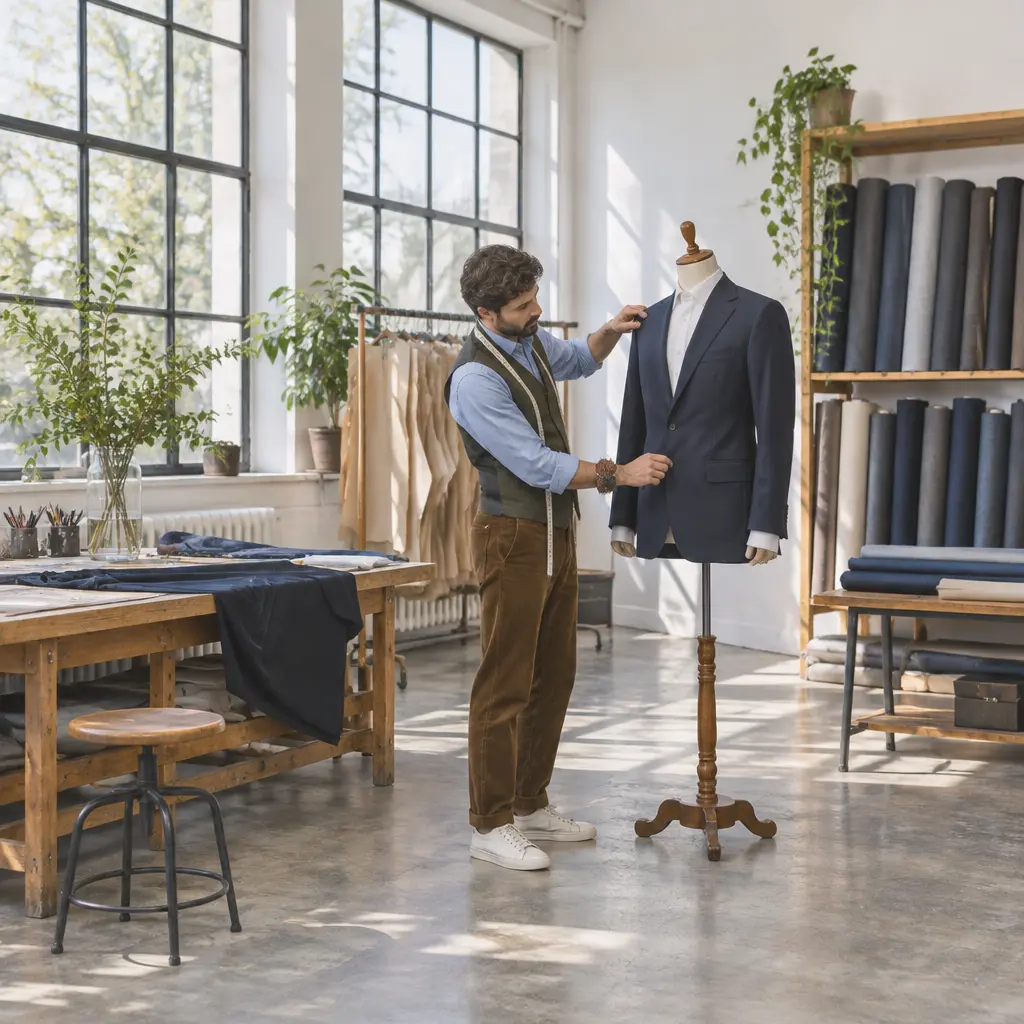
A well-made suit can be altered and repaired, extending its useful life; secondhand purchasing and rental also offer alternatives to buying new. These options matter in a clothing sector with substantial environmental impacts. The United Nations Environment Programme has highlighted the fashion and textile sector’s resource use and pollution, while noting that extending garment life and changing production and consumption practices are part of the response.
For consumers, practical steps include choosing a versatile color and fit, checking the garment’s fiber and construction, using a skilled tailor for adjustments, and repairing buttons or linings before replacing the suit. Such choices connect the suit’s history of durability and adaptation with contemporary concerns about waste.
Conclusion: The Business Suit as a Changing Social Signal
The business suit evolved from the frock coat and lounge suit into a coordinated garment shaped by industrial production, office culture, changing gender roles, and new ideas about professional identity. Its forms—from two-piece and three-piece suits to women’s pantsuits and modern separates—show that tailoring is not a fixed uniform. It is a flexible language through which people communicate formality, authority, belonging, and personal style.
As workplaces continue to change, the suit’s importance lies less in daily necessity than in its ability to adapt and carry meaning. Readers interested in its next chapter can explore museum costume collections, examine how local workplaces define professional dress, or consider repair and resale before purchasing a new suit.
Sources: John Carl Flügel, The Psychology of Clothes, 1930, https://archive.org/details/psychologyofclot00flug; The Metropolitan Museum of Art, The Costume Institute: Collection, https://www.metmuseum.org/about-the-met/collection-areas/the-costume-institute; National Park Service, The Garment Industry, https://www.nps.gov/articles/000/the-garment-industry.htm; National Museum of American History, The History of Women’s Fashion, https://americanhistory.si.edu/explore/stories/history-womens-fashion; U.S. Senate, Women in the Senate, https://www.senate.gov/artandhistory/history/minute/Women_in_the_Senate.htm; U.S. Bureau of Labor Statistics, American Time Use Survey—2023 Results, https://www.bls.gov/news.release/atus.nr0.htm; United Nations Environment Programme, Sustainability and Circularity in the Textile Value Chain, https://www.unep.org/resources/report/sustainability-and-circularity-textile-value-chain-global-stocktaking.